
Conjunctivitis: Bacterial — MCQs

Which of the following findings is typically NOT seen in a patient with allergic conjunctivitis?
A 25-year-old male presents with recurrent bilateral conjunctival hyperemia and a gritty sensation. Likely diagnosis?
All of the following conditions are immediate priorities in the WHO's "Vision -2020: The Right to sight" except:
What is the causative agent of angular conjunctivitis?
Which of the following is NOT a feature of iridocyclitis?
Regarding Chlamydia infection of the eyes, true statements include the following except:
Image-based question: Diagnosis is:
A 52-year-old male outdoor worker presents with a fleshy growth in his left eye associated with foreign body sensation and redness for 3 years. On examination, a triangular fibrovascular tissue is seen arising from the nasal conjunctiva and encroaching 3 mm onto the cornea, crossing the pupillary axis. Best-corrected visual acuity is reduced to 6/18, and keratometry reveals significant with-the-rule astigmatism. There is no evidence of active inflammation. What is the most appropriate management for this patient?
Best treatment for a small boy with itching in summers and Horner-Trantas spots:
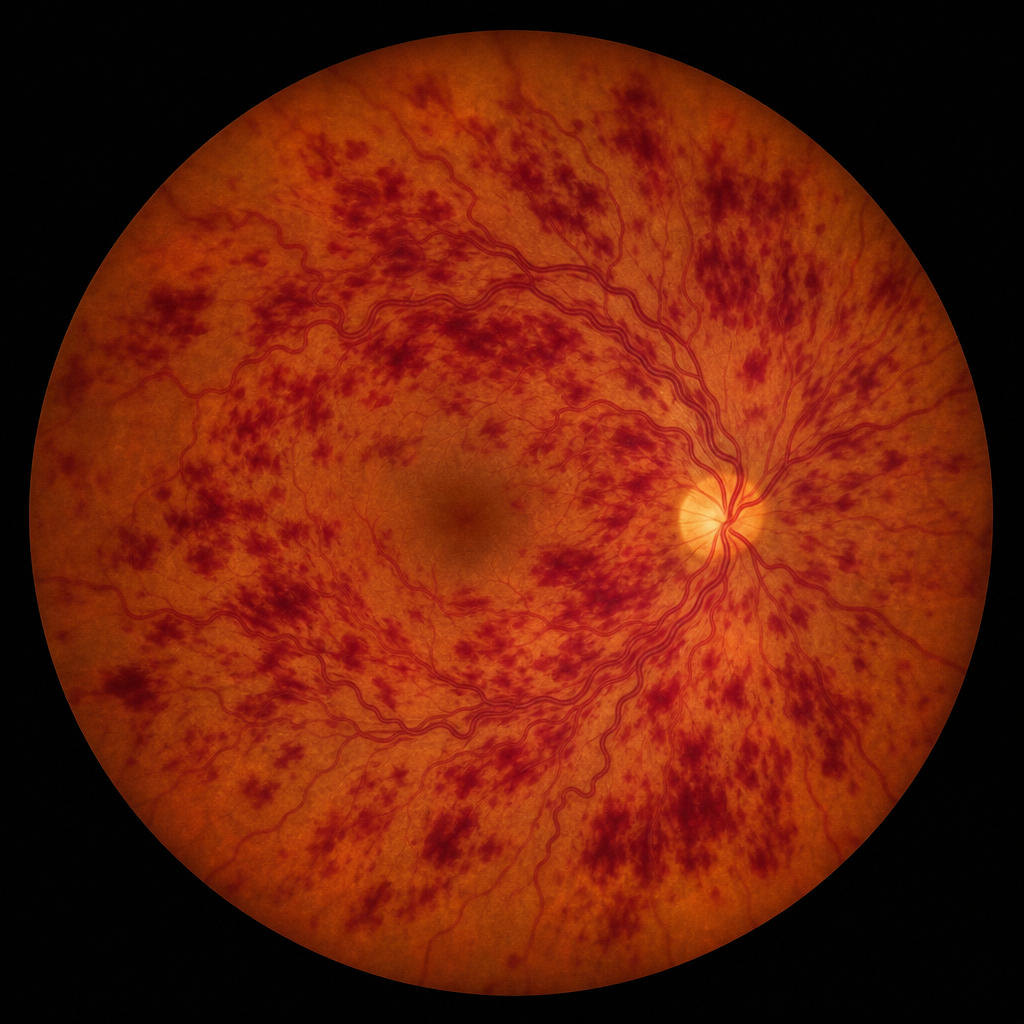
A 58-year-old hypertensive woman presents with sudden painless loss of vision in her left eye noticed on waking. Her blood pressure is 168/96 mmHg. There is no relative afferent pupillary defect. The fundus photograph of the left eye shows diffuse venous tortuosity and widespread retinal hemorrhages in all four quadrants, consistent with central retinal vein occlusion (Image 3). Which of the following investigations is most important to guide immediate management and reduce the risk of neovascular complications?
Want unlimited practice?
Get full access to all questions, explanations, and performance tracking.
Scan to download app